What Aren’t we Doing?
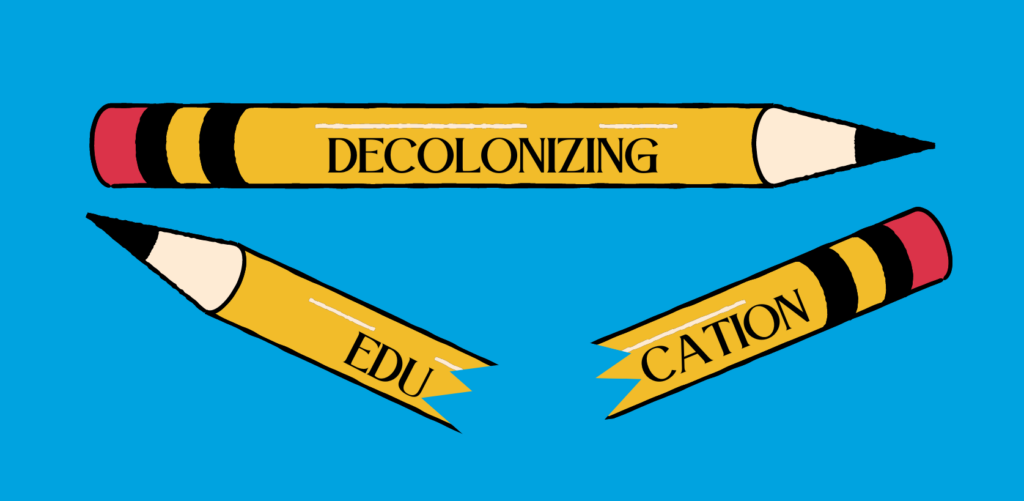
For this first post, I thought it was important to step into the reality of what the education system looks like for many people of colour in our community, not the immediate tragedies you see on the news or the easy-to-spot discrimination, small moments most people wouldn’t even have to think about, because they have the privilege not to. The quiet acts of discrimination within the education system are what make it so difficult to change, because to most, the discrimination is difficult to spot. I have conducted an anonymous interview with an educator in the community to discuss their experience as a person of colour in the education system, both as a student and as an educator, and the changes (or lack thereof) they have seen over the years.
For these interview questions, I wanted to do a bit of a past, present, and future look at our education system. Where did we start, where are we now, and what needs to change? It is important to emphasize that when looking at these questions, it is one perspective, and every person of colour has had a different experience within the school system. I also want to emphasize that these questions are not a reflection of individual educators, but the education system itself, and how we can not only individually take steps to make a classroom more integrated, but also advocate for the system itself to become more inclusive.
Interview Questions:
Question 1
Let’s start at the top: growing up as a person of colour, did you see much representation of yourself and your community in the school system?
Answer
As a child, it was very rare to see books in the classroom bookshelf or the library that represented me. I loved reading and exploring stories, but none of the characters were representative of a young black girl. Every time I imagined myself in the story, I changed myself to represent the characters rather than taking pride in my traits (kinky brown hair and brown skin); I yearned for “yellow locks, brown ringlets” and “skin as white as snow, as fair as porcelain”.
Question 2
Beyond representation within the class, did you feel welcomed into your learning spaces, not just included, but did you feel as though you were a member of the classroom, as though you belonged?
Answer
The community I grew up in at the time was not very diverse and did not have a representation of many cultures. I was the only black child at my school, and differences can sometimes be viewed as “odd”. Children identify more strongly with their racial groups, so it was difficult to make connections with my peers. I was very strong at school and enjoyed being in a classroom because I felt it was a safe place with the adults, and I was empowered by my ability to read and write.
Question 3
Did you often face discrimination within the learning environment? From classmates, teammates, or even educators?
Answer
I did feel discrimination from the students due to their lack of exposure to other black children. The students began to form judgments based on stereotypes and verbally point out differences in skin colour, hair texture, and other physical traits.
Question 4
Let’s jump forward a bit. As an educator, do you see your students being fairly represented within the classroom and the school?
Answer
I have spent an enormous amount of time ensuring that my classroom and school community are representative of the diverse cultures in the school community.
Question 5
Do you see yourself being fairly represented?
Answer
After 2020, there was a big push for more representation of the black communities in school…even a Black Shirt Day…but slowly this dissipated, and this year there was no mention at all.
Question 6
How do you implement inclusion into your classroom so all students feel as though they are welcome, wanted, and included in the learning environment?
Answer
At the beginning of the year, during parent/teacher interviews, I send home a cultural survey form for families to fill out. Once the forms are filled out in November, I have a cultural festival in the classroom. Each child creates a posterboard with pictures of their families, they bring in any traditional clothing or artifacts, and each class brings in a dish to share. The families are invited in so that they can mingle with our families in the classroom and celebrate the diversity that makes up our classroom family. Over the years, the feedback from families has been overwhelmingly positive. It was seen as an opportunity for culture to be displayed rather than hidden/masked.
Question 7
How has the education system changed since you were a student? Do you see more inclusivity and integration? Less?
Answer
There has been more focus on cultural diversity over the past decade.
Question 8
In a primarily digital age, have you noticed the effects of limited online surveillance for students impacting their experiences within classroom communities? ie. cyberbullying, inappropriate content/language, etc.
Answer
Cell phones, chrome books, ipads are still in schools and accessible to students, especially in high school. There are rules about cell phones in the classroom, but they are loosely enforced.
Question 9
Would you say that the wide range of internet access has led to students using racialized language or crude comments towards classmates unaware of the comments because of what they see online, without understanding what the content they are seeing/digesting entails?
Answer
Due to the impact of AI exposure to one film, meme, advertisement and reading the content (accessing the page out of curiosity can lead to the algorithm changing), suddenly there are more racially biased ads, content, meme’s etc. which has the possibility of impacting the subconscious, and students repeating what they are seeing/hearing leading to more racialized language being used in the schools. \look at “67” and how fast it spread. \groups are very aware of how quickly messages, whether false or truthful, can be spread through youth on social media.
Question 10
Finally, would you say that the responsibility of decolonizing education and centring student environments around integration and welcome falls more on the individual educators rather than the education system?
Answer
I believe that the education system is making a concerted effort for the pendulum to swing to a more diverse and inclusive education for students. I believe that as new, younger educators come into the field and start their careers, this wave of inclusion will continue to be at the forefront of educators and the systems’ curriculum.
Summary:
This week’s post was quite word-heavy, but definitely emphasized the point that discrimination and colonial learning within the learning environments are a system fault, not one of any individual. Though great strides have been taken in the past decade, many of the actions taken by the system have been a point of show, such as “Black Shirt Day.” Most of the real inclusion comes from individual educators, and while this stresses the importance of an educator’s impact on their students, it also tells us there is a lack of change within the system, which is falling once again on the educators with little to no support or guidance.
This inquiry project is not made to attack the system, but to point out obvious missteps that can easily be addressed, such as asking students to dress in certain colours as a way of “showing” that they are inclusive, rather than educating students on the issues and teaching them how to confront stereotypes and bias. The system has come a long way in recent years, but how can we as educators continue to explore, confront, and decolonize the system from within? What can we do?